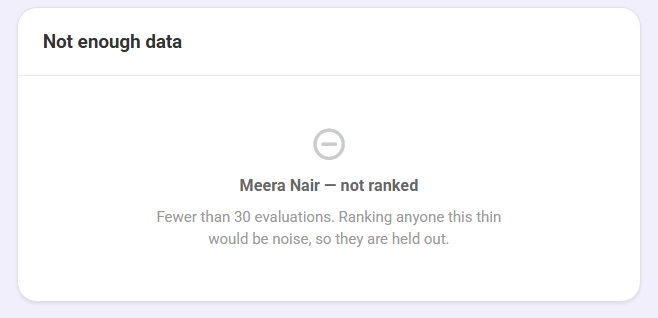
Initial approach. Building the Claralens analytics layer, I defaulted to the obvious: every insight card shows a score. A number in every cell felt like completeness.
Where it broke. On small or sparse interaction sets, a raw score misleads. Five interactions scoring 100% isn't a good agent — it's five interactions. Ranking on numbers like that manufactures false confidence, and in BFSI that confidence gets acted on.
Resolution. I made emptiness explicit. "Not enough data" is now a first-class UI state — never a blank cell, never a zero standing in for absence. Template Health became a prerequisite gate: if the instrument isn't sound, nothing downstream is trusted. Ranking uses the Wilson lower bound with a minimum-N threshold, so a position has to be earned. Every number renders alongside its coverage and denominator, with NA checkpoints excluded from the denominator rather than counted as failures.
The principle underneath: the dashboard's job isn't to look full. It's to say when it knows something and when it doesn't. A confident wrong number costs more than an honest gap.