Why SLA got miscalculated? And what to do?
In a meeting with a Client, we noticed that both parties had different numbers on downtime, and SLA period. Majorly this was because everything was manual, but even with making it more structured has its challenges.
Lets start from the top.
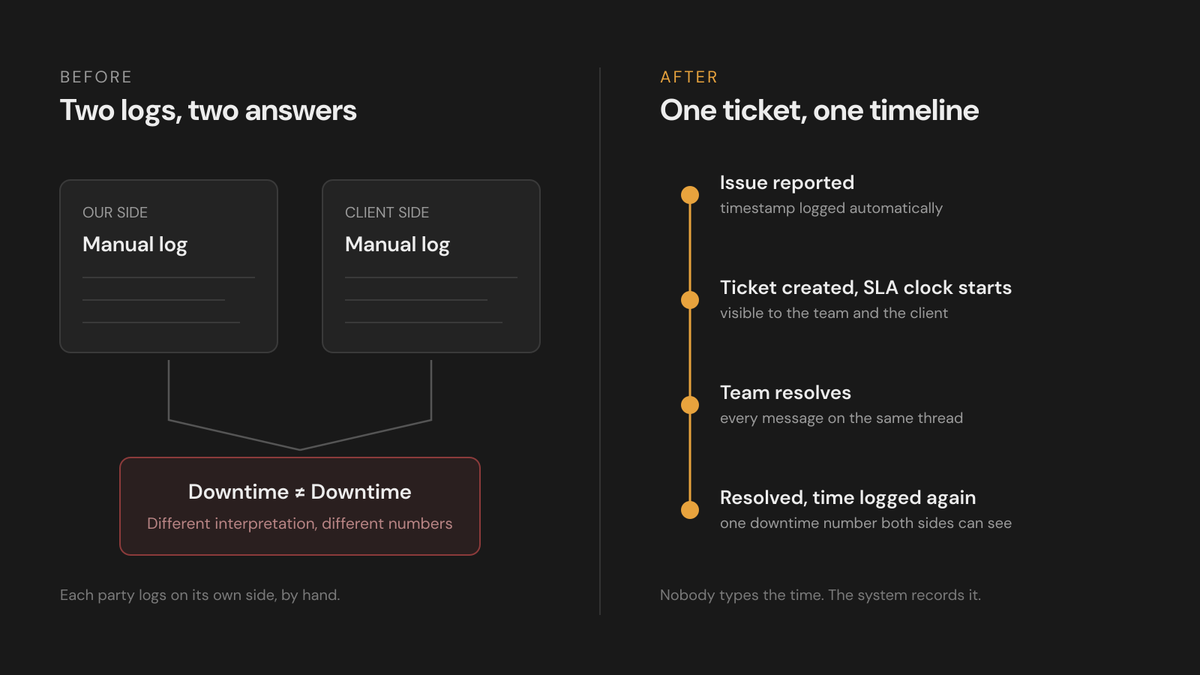
The client counted 38 hours of downtime. We counted 17. Both sides were logging it by hand, and both were acting in good faith. We moved to automatic ticketing, which fixed the mismatch but brought three new problems. Here's how we're handling each one.
What happened. In a client meeting, the client was frustrated, and rightly so. There had been a lot of downtime over 3 months. Resolution was quick and timely: sometimes 2 minutes, sometimes 4, 10 or 30 minutes, once 3 hours. But when we sat down to calculate the total downtime and total SLA, the client said 38 hours and we said 17. More than double. The client didn't like it. They said that if we own everything, we should be the ones calculating the business loss. Again, the client is right.
Why the numbers didn't match.
- Manual logging. Both parties were capturing it on their own side, so of course it mismatched, based on each side's interpretation and on the actual business rules.
- False alarms counted as downtime. Some cases weren't our downtime at all. The internet was down on their side, and they thought the dialer was down. On their sheet, that was downtime. On ours, it wasn't. With nothing shared, there was no way to settle it.
What we changed. We made the process structured, so the timestamp is logged automatically from the moment there's a downtime, or the moment anyone reports a technical issue. So we introduced a ticketing system. Introduced not as in creating something extraordinary new. It already exists in most enterprise solutions. When we built it for our products, we made sure it's easy for anyone to raise a ticket.
- When a ticket is made, the time and the SLA are recorded.
- The team sees the ticket and resolves it, and the time is recorded again.
- Every party can see the messages, the timestamps and the full timeline.
- A false alarm still gets a ticket. It's just closed with the real cause, so both sides can see it wasn't platform downtime.
So the first challenge was solved. Then came the next ones.
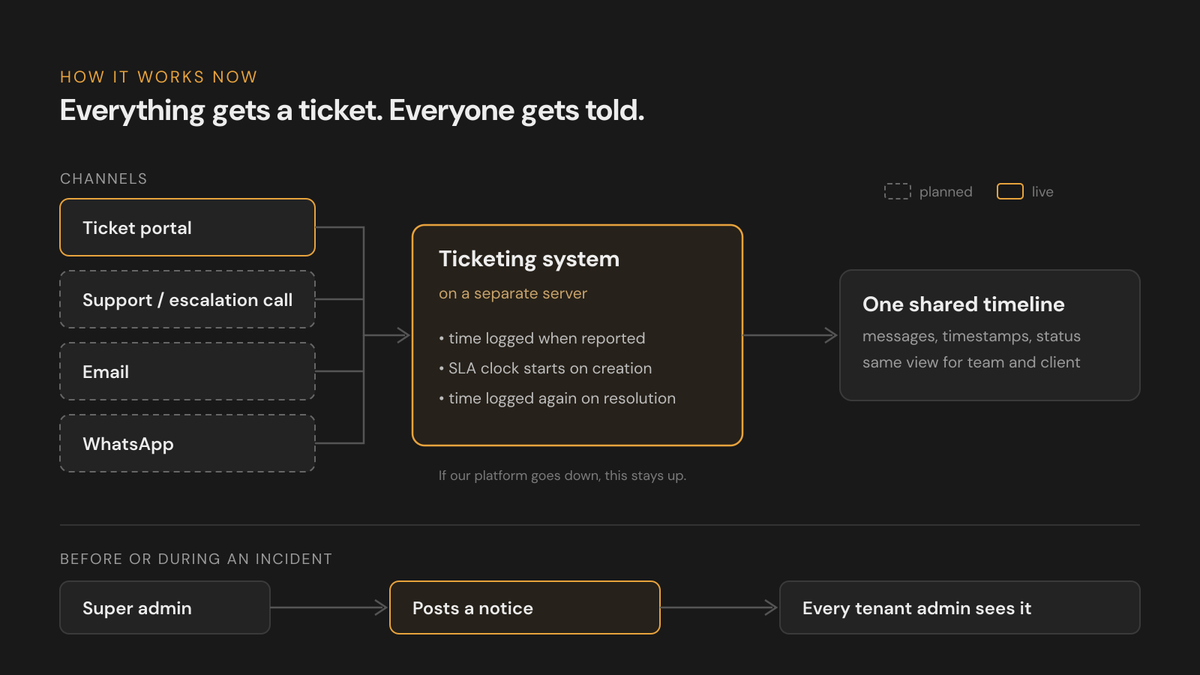
New flaw 1: if the system is down, the ticketing portal can go down too. Not always, but there's a chance. So we moved the ticketing system to a separate server. If our platform goes down, the portal doesn't go down with it.
New flaw 2: not every issue gets reported through the portal. People call, email or send WhatsApp messages. So we're planning to record omnichannel tickets as well. If someone calls an escalation or support number, a ticket must be created. If an email comes in, a ticket is created with the same timestamp and recorded in the portal. Same for WhatsApp. Everything gets a ticket.
New flaw 3: the client wants to know before it hurts them. The client said that if there's a downtime or any accident, they want to be told in advance, or at least on time, so they can take corrective measures. So we added a notice system to the platform. The super admin can post a notice, and every tenant admin sees it.
Has it worked? Too early to tell. What I'll watch: whether the next SLA review ends with one number instead of two, how many tickets turn out to be false alarms, and our median resolution time.
What I learned. We were arguing about whose number was right, when the real problem was that there were two numbers. If the client is paying for uptime, the proof of uptime has to be something both sides can see. And every fix brought the next problem with it. That's fine, as long as we keep writing them down.
Still open. What about downtime nobody reports? If the system goes down at 2 a.m. and no one raises a ticket until 9, which time counts? I think the answer is monitoring that opens the ticket on its own, but we haven't built that yet.